Summary //
- Many probably underappreciate the role that traditional oil and gas companies have in addressing climate problems and providing solutions.
- For the foreseeable future, natural gas and natural gas liquids are going to have an important role to play in reducing global emissions as a replacement for dirtier fuels.
- Midstream companies are helping facilitate the use of cleaner energy today with more opportunities likely as progress is made with renewable fuels production, carbon capture, and hydrogen, for example.
Discussions of environmental, social, and governance (ESG) factors and the energy transition have pervaded the traditional oil and gas landscape from management remarks on earnings calls to investor presentations. The industry is making a concerted effort to address ESG-related concerns and questions around the role of oil and natural gas companies in an energy transition. Midstream has been active on this front as well. While past Alerian research has focused on midstream’s progress with ESG-related metrics and sustainability reporting, which have continued to improve, today’s note focuses more on the case for why an investment in midstream can be an ESG-conscious investment, specifically from an environmental perspective.
Oil and gas companies have a role to play in providing cleaner energy and reducing emissions.
Many probably underappreciate the role that traditional oil and gas companies have in addressing climate problems and providing solutions. Energy companies from the integrated majors to refiners to midstream are investing in renewables and clean energy technologies for the future (read more), but many are already involved in activities that support cleaner energy today. For example, Valero (VLO) is the largest refiner globally, but it is also the world’s second-largest producer of corn ethanol and renewable diesel. Other refiners also produce renewable fuels and support clean energy in more subtle ways. For example, refiner Phillips 66 (PSX) produces special types of petroleum coke used in the lithium ion batteries of electric vehicles. In midstream, Kinder Morgan (KMI) noted at its recent Investor Day that it is not only one of the largest handlers of ethanol in North America, but it also facilitates the movement of renewable diesel and related feedstocks like vegetable oils and fats. MLPs with refined product terminals, including MPLX (MPLX) and Magellan Midstream Partners (MMP), are actively blending renewable fuels (ethanol, biodiesel) today.
Additionally, oil and gas companies have existing expertise with carbon capture and storage (CCS), which is expected to play a critical role in reducing emissions. The chart below from ExxonMobil’s (XOM) 4Q20 earnings presentation is based on data from the International Energy Agency (IEA) and helps frame the need for CCS under the IEA’s Sustainable Development Scenario, which aligns with the Paris Agreement. As noted on the slide, CCS is expected to mitigate 15% of total emissions, and without CCS, the cost of achieving a 2-degree Celsius target would increase by 138% per the Intergovernmental Panel on Climate Change (IPCC). Captured carbon dioxide is often used in enhanced oil recovery (EOR), which involves pumping carbon dioxide into oil reservoirs to increase production and extend productive life. Occidental (OXY) is one of the industry leaders in carbon management and plans to utilize EOR and CCS as part of its goal to achieve net-zero operational and energy-use emissions by 2040. Within the midstream space, KMI is the largest transporter of carbon dioxide in the US and uses captured carbon to produce oil through EOR. Increased use of CCS may necessitate more pipeline solutions in the future to move carbon dioxide from where it is generated to where it can be disposed through EOR, creating potential opportunities for midstream.
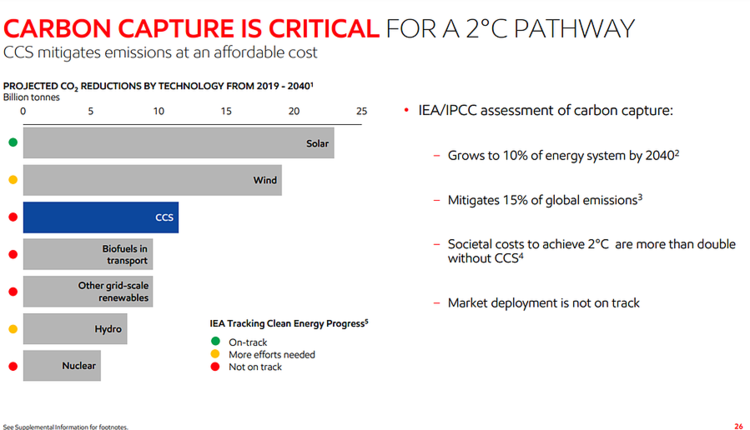
Source: ExxonMobil 4Q20 earnings presentation
Natural gas and natural gas liquids have an important role to play in reducing emissions.
For the foreseeable future until renewables are affordable, reliable, and widely available, natural gas is going to have an important role to play in reducing global emissions. Typically, coal-to-gas switching is top of mind on this front, but there are other ways in which natural gas and natural gas liquids (NGLs) can help improve overall emissions. In 2019, coal remained in the top spot for global power generation at 36% according to the IEA. In the US, coal provided 24% of power generation in 2019 and an estimated 20% in 2020 per the Energy Information Administration (EIA). At their recent ESG Day, management of Williams Companies (WMB) highlighted that there are 77 coal power plants along the Transco pipeline route from Texas to New York. If all converted to natural gas, it would lower carbon dioxide emissions by more than 380 million metric tons, equivalent to removing 84 million cars from the road, while also requiring 12 billion cubic feet per day of new pipeline capacity.
Beyond serving as a replacement for coal in power generation, natural gas and NGLs can help reduce emissions in other ways. Municipalities, airports, and companies such as Amazon (AMZN) and UPS (UPS) have deployed or signed purchase agreements for trucks powered by compressed natural gas, which emit 27% less carbon dioxide relative to diesel fuels. While some of these vehicles will consume renewable natural gas – produced from dairy farms or landfills – for an even cleaner profile, limited availability means that conventional natural gas will also be needed. More broadly, NGLs such as propane and butane (also referred to as liquefied petroleum gases or LPGs) with their cleaner burning profile are helping reduce global emissions by replacing biomass, kerosene, and other dirty fuels often used for cooking or heating. Pollution from burning biomass is not unique to developing countries. In the San Francisco Bay Area, wood smoke from fireplaces and stoves is the largest source of fine particulate pollution during the winter, and new buildings are not allowed to include wood-burning devices, though natural gas fireplaces are permitted. The Bay Area Air Quality Management District recommends citizens use a gas or propane grill rather than a wood or charcoal cooking tool.
Whether as a replacement for coal in power generation or wood in household cooking or heating, natural gas and NGLs are helping to reduce emissions globally with more progress still to be made. Clearly, the production of natural gas (and oil) generates emissions, but as shown below, Canada and the US have relatively low emissions intensity when compared to other leading producers of oil and gas.
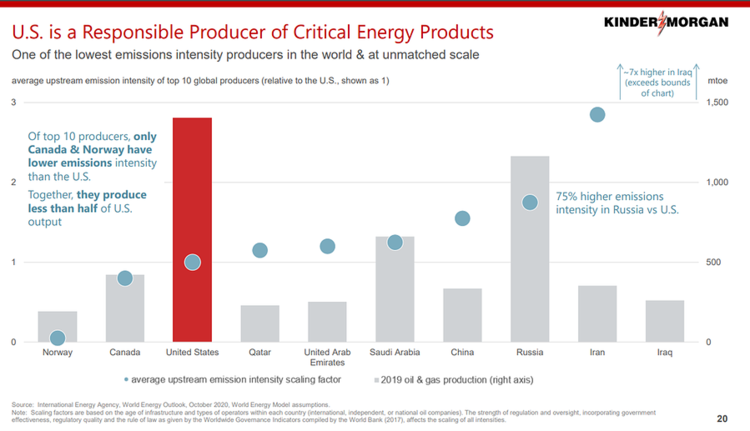
Source: Kinder Morgan’s 2021 Investor Day Presentation
How can an investment in midstream fit with an environmentally conscious investing approach?
As discussed in prior research (read more), midstream is taking steps to reduce emissions, source more renewable power, and evaluate renewable-focused projects, with Energy Transfer’s (ET) announcement of the formation of an Alternative Energy Group last week providing one example. Midstream companies are blending and handling renewable fuels and feedstocks today, transporting renewable natural gas, and specific to KMI, actively involved in carbon capture and storage. Enbridge (ENB) has a renewables portfolio including wind, solar, and geothermal assets, while TC Energy (TRP) has two clean energy pumped hydro storage projects. Midstream’s involvement in transporting and processing natural gas and NGLs is also helping facilitate cleaner energy use in the US and abroad through exports – a contribution that should merit inclusion in green portfolios according to the President and CEO of WMB. Indeed, nearly 1 million WMB shares were held by a variety of ESG-focused ETFs as of September 30, 2020, with ownership having increased as the company has progressed ESG goals and is targeting net-zero emissions by 2050. In the broad Alerian Midstream Energy Index (AMNA), nearly 70% of the index by weighting is primarily focused on activities related to natural gas and natural gas liquids – transportation, gathering and processing, or liquefaction.

With the energy transition in early innings, midstream could see more opportunities to facilitate the use of alternative energy in the years ahead. The conversion of some refineries to renewable diesel could create opportunities to supply feedstocks or distribute finished fuels through existing infrastructure. Current natural gas pipelines could transport 5-10% blends of hydrogen if both supply and demand were in place, and broader adoption of hydrogen could require tailored pipeline capacity. Hydrogen derived from natural gas with a carbon capture component could also create opportunities for midstream.
Bottom line
Many probably underappreciate the role that fossil fuels and traditional oil and gas companies have in providing clean energy solutions. Midstream is already taking steps to support cleaner energy use with the potential for more opportunities as progress is made with renewable fuels, carbon capture, and eventually hydrogen.
Related reading:
Going Green: Oil & Gas Dips its Toes Into Renewables, June 2020
Assessing the Threat of the Energy Transition for Oil and Gas, August 2020