
The recent flows back to emerging markets coupled with looming fears over China’s slowing growth rate have prompted many to ask whether or not India is poised to overtake the incumbent economic powerhouse of Asia.
While there are plenty of metrics and views that suggest India may very well assume China’s position as the world’s leading developing economy in the coming years, this will be no easy feat given the structural obstacles that lie ahead.
Demographic Trends Work Both Ways
If demographics are destiny, then India has China beat hands down. A country’s economic growth potential is constrained by its labor force and productivity growth rates. Recent UN projections suggest that China’s working-age population, the lifeblood of any growing economy, has peaked and may even decline by as much as 15% by 2040. At the same time, India’s working-age population is slowly but surely catching up and is expected to breach the 1 billion mark by 2030. Meanwhile, China’s increasing dependency ratio will only weigh down on the country’s growth potential from a demographic perspective.
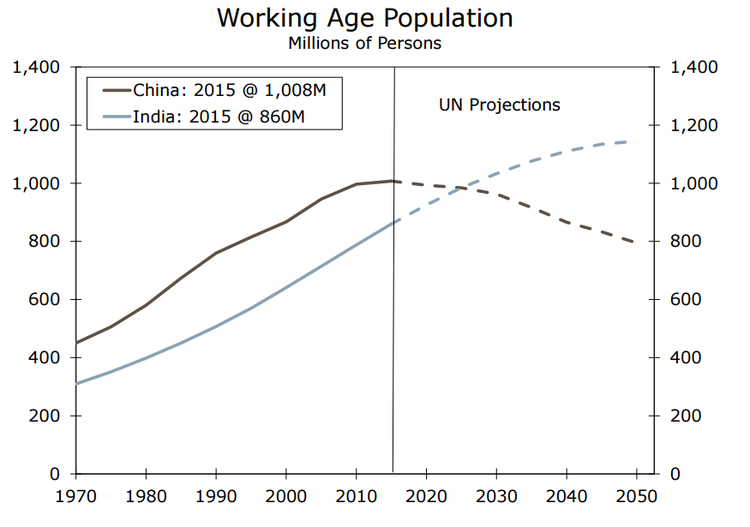
Furthermore, as a recent report from Wells Fargo points out, labor force participation among females in India remains comparatively low; as such, India boasts even greater potential when we consider that its economically active population is potentially on the cusp of a breakout.
Ultimately, the tailwinds of a booming population that aided China’s growth between the ’80s and today will inevitably turn to headwinds, while India’s favorable demographic trends still have plenty of room to run, so to say.
Economic Growth Potential
In absolute terms, China’s GDP dwarfs India’s economic output five-fold: approximately $10 trillion vs. $2 trillion, respectively, as of 2014. Not surprisingly, China also has India beat in terms of GDP per capita: $3,800 vs. $1,200, respectively, which is an important metric when it comes to evaluating the strength of the local consumer.
The comparison diverges, however, when we view these metrics through a growth lens.
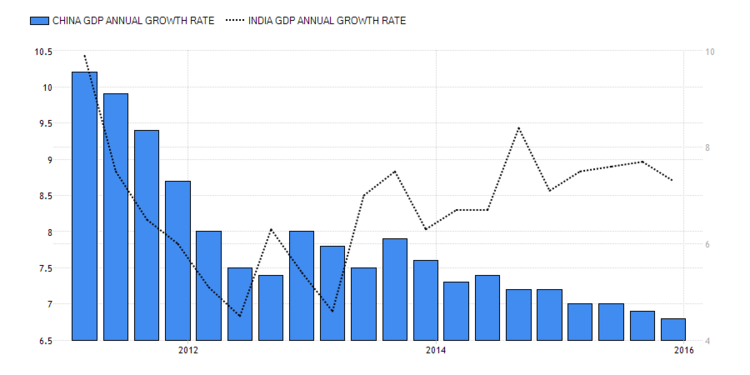
As the graph above demonstrates, China’s once hot GDP growth has slowed down considerably over the past five years, most notably dipping below the double-digit mark. India’s annual growth, on the other hand, has been steadily trending higher since 2013.
Simply put, China’s glory days are likely behind it. While this doesn’t at all imply the country is doomed, it does suggest that India has the potential to easily overtake China when it comes to economic growth potential in the coming years.
Local Conditions
Now let’s consider some less-talked about metrics that evaluate each of the country’s local conditions and how conducive they are to supporting economic growth.
Ease of Doing Business
According to the World Bank, the ease of doing business ranking quantifies how conducive the regulatory environment in the country is to the starting and operation of a local firm. This metric is key in today’s economy as entrepreneurs worldwide are accounting for a growing share of global GDP growth. In this respect, China outranks India by a fairly wide margin, taking the 84th spot (far from the top still) versus the 130th spot.
Infrastructure
Based on the latest global competitiveness rankings from the World Economic Forum, China’s infrastructure ranks 39th globally versus India, which ranks far behind, claiming the 81st spot.
Education
Although it is difficult to quantify education metrics in many respects, this is still an important benchmark, especially in the context of today’s rapidly changing, and increasingly digital, global economy. According to the UN’s 2015 Human Development Report, China falls in the “high” development category, claiming the 90th spot; this trumps India’s spot in the “medium” development category and 130th ranking by a sizeable margin.
Overall, China appears better situated to continue fostering economic growth compared to India, which still has a lot of catching up to do when it comes to creating favorable conditions for the local population.
Global Importance
McKinsey & Company recently published a globalization report that highlights each country’s importance and “connectedness” in today’s digital economy.
The key theme here is that data and information flows are now generating more economic value than the global trade of physical goods. With that said, China trumps India in terms of importance and connectedness on the global stage:
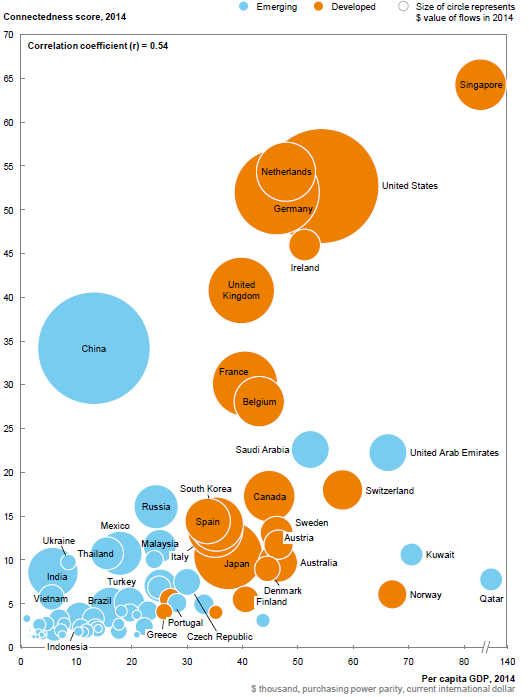
China boasts a connectedness score of 34.2, whereas India trails far behind with a mark of 8.5.
The same is true when it comes to economic importance.
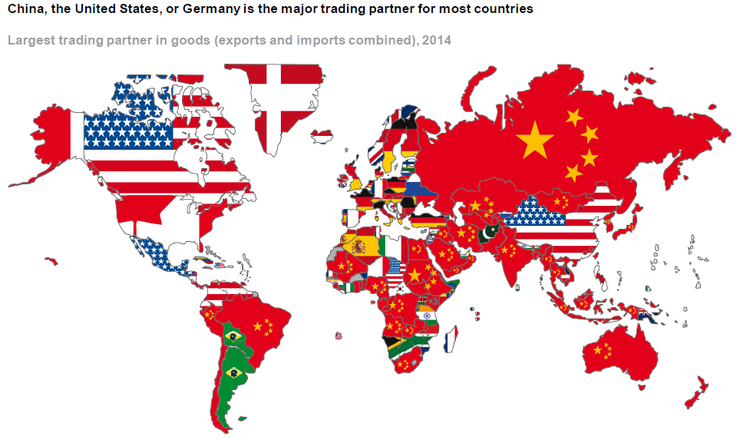
As the visual above clearly demonstrates, China is the largest trading partner for most of Asia, Africa, and even South America.
From a global importance perspective, India has lots of catching up to do to even be considered a formidable adversary to China.
Outlook
India has China beat when it comes to economic potential, seeing as how this nation has yet to enter the super-charged growth phase that characterized the Chinese economy over the past two decades. However, India trails far behind its neighbor in a variety of metrics, namely favorable local conditions conducive to economic growth.
With that said, while India certainly has the potential to overtake China one day, especially when we consider its demographic tailwinds, this is still years away.
Ways to Play
Investors have plenty of options when it comes to establishing exposure to either India or China.
For starters, here are some of the most popular options to consider:
- iShares China Large Cap ETF (FXI ).
- Harvest CSI China A-Shares Fund (ASHR ).
- MSCI India Index Fund (INDA ).
- India Earnings Fund (EPI ).
See the full list of:
The Bottom Line
All in all, China’s economy, albeit slowing, is still the emerging economic powerhouse of the world and it doesn’t appear to be under threat of being dethroned by India in the coming five years.
Follow me @SBojinov

