

Evan Harp sat down with Jim McBride, Jesse Lehmann, and Kara Loop of the McBride Group as well as Charles Schwab’s Rob Maiorano to discuss the McBride Group’s latest offering to the advisor community.
Evan Harp: Thank you all for joining me today, can you tell me a little bit about the McBride Group and what you all do?
Jim McBride: We’re a registered investment advisor with the state of California. I formed the firm 16 years ago after having worked at Merrill Lynch for 18 years. So, I’ve been in the investment business for 34 years. Also about 21 years ago in 2004, I achieved certification as a Certified Financial Planner™. When we started the firm, we built it with the idea of being a fiduciary and we established ourselves in our initial registration with the SEC as being fee only.
Video Updates as Client Communication
Evan Harp: The McBride Group offers a unique service that involves leveraging the power of video updates for other financial advisors as a means of client communication. Can you talk to me a little bit about that?
Jim McBride: Well, 34 years ago, when I joined Merrill Lynch, I also started working at the local TV station, KFTY 50 in Santa Rosa, California. I fulfilled a lifelong dream of being on television and I’ve been doing that for a number of years. For the last seven years, I’ve worked at the Fox affiliate in the San Francisco Bay Area, KTBU. You may have seen some of my air checks on our website on the television tab.
About nine years ago, we were sending an email or a letter to all of our clients, just giving them an update on their account and our thoughts upon the market. But then, talking to some of the friends that I met way back when at KFTY, I came up with the idea of doing a video update for all of our clients.
Well, now we’ve been doing that, believe it or not, every month for nine years. The clients quite frankly love it. Our videos are well done and professionally produced because the folks that do that work have been working in the industry for 30 plus years. And then last year we got the idea that this might be something that we could put out to our other RIA colleagues throughout the United States.
We have a tremendous working relationship with Schwab, which is absolutely the best firm to work with if you’re an RIA, and we just think that that might be of interest to our colleagues. So what we’re trying to do is get the word out, see if they’re interested, and we want to make our videos available to them.
Video vs. Text Communication
Evan Harp: Talk a little bit about what the advantages of video update might have over any email or something that you send in the mail to your clients?
Jim McBride: We think it brings a whole different level of professionalism when you’re talking about video versus when I got into business 30 plus years ago. People were sending out these newsletters and now more recently blogs, and one of the things that those methods, for all of their value… They’re not short, they’re not sweet. There’s no brevity. Whereas our videos are very professional, consistent and right to the point. The whole point of our communication isn’t to tell people how smart we are – we’re trying to tell people that we care about them and their situation. One of the things that I’ve always believed is people have to know that you care before they care what you know.
We are a referral-only business. We have found that communicating with our clients in a good market or in a bad market has allowed us to increase revenue, increase referrals, and increase retention, and we believe this level of consistent quality client communication to be very beneficial to our business overall.
We’re looking for a situation whereby other RIAs can avail themselves of our production services to increase their revenue, retention, and referrals. That’s sort of the long and short of our endeavor.
Jesse Lehmann: I came on not realizing how much of Jim’s job is actually video production. He’s constantly filming, constantly editing, he’s got a whole staff that’s dedicated towards producing these extremely high quality videos. Jim doesn’t lose clients, period.
The Value of Soft Skills
Evan Harp: It makes a lot of sense because there’s a lot of different ways that people absorb information. I know sometimes it’s easier to hear a human being tell you something than it is to read and absorb, for many. There’s a time and place for everything, of course. I wanted to ask, financial services is an industry that particularly values, perhaps unfairly, what we call quote unquote “hard skills” like data analysis. Can you speak a little bit to the value in leaning into improving your “soft skills,” like communication?
Jesse Lehmann: It’s funny because communication is in itself a soft skill. Jim is a unique RIA in that he’s got a plethora of both the hard analytical skills necessary to have profitable portfolios, but he leans into his own soft skills like communication. More than anything, he is communicating consistently. His clients hear from him at the beginning of the month, every month. And that is where a lot of our strength comes, is from those soft skills.
Communicating with your clients is something that every single RIA has to do. They have to communicate with their clients. They can’t just take all of your money, put it into a portfolio, and then disappear. Everything we’re doing, in fact, right now, is a lean into the soft skills. That’s exactly what we’re doing. Hard skills, we’ve got them down. We know where to put your money. We know how to invest it properly. We’ve got that down. And that’s true for a lot of RIAs.
Many RIAs, however, need to help with their soft skills. And we can take the impetus of client communication off their plate completely and give them something that is above standard. It’s definitely worth it to us to keep trying to get the word out so that people can avail themselves of our service.
Jim McBride: Case in point, we were having lunch with some clients last week to review their portfolio, they’ve been with us for about 10, maybe 12 years. They have a very nice portfolio, $1.3 million. We were able to show them that their investment gains are about $632,000. And the husband said, “I really like your videos.” And I wanted to say, “well, what about the great financial results?”
But that’s a perfect example, I think, of the soft skills that Jesse was talking about. Because they know that we care about them and their situation. And somewhat surprisingly, the money, the performance, it was secondary.
Advantages of Direct Communication
Evan Harp: That totally tracks from my own understanding of how people work. People want to be seen and they want to be heard, and having the right kind of touch points is really important. I had another question I wanted to ask you about this, what’s been the most surprising thing you’ve noticed about your service or the reaction to the service and just how has the reaction been from the RIAs that you’ve worked with and helped out in this way?
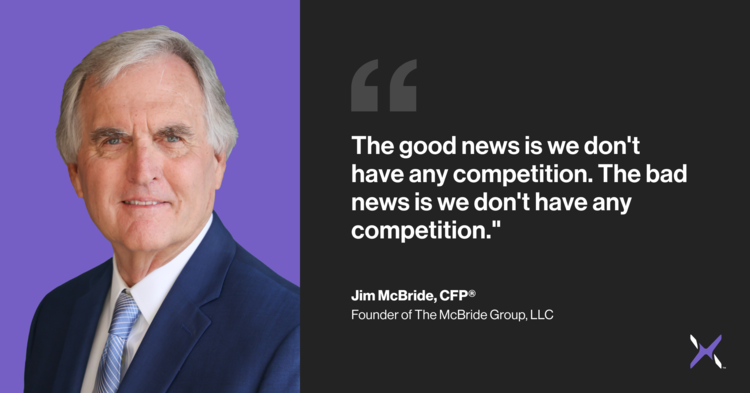
Jim McBride: We haven’t had much reaction from the RIA world because they don’t know that we’re here. As I tell my team, we have an outstanding product. In fact, I think we’re the very best. So, the good news is we don’t have any competition. The bad news is we don’t have any competition.
Jesse Lehmann: We’re hard to measure how we are and how good we are unless you get on the internet and look at some of the stuff that people put out there, which is, it’s cringe-worthy, to put it politely. Yeah, so Jim and myself, we get frustrated with the same canned newsletters, the same canned blogs. There’s a saturated level of client communication that’s just templated garbage.
What we’ve worked to do is set ourselves above all of that by providing direct communication. I don’t know if you had a chance to look at our sales video, but what we do is we take our market update and we put in any RIA’s branding, contact information, everything on the video, and we send it to them to send to clients. Our real goal, truly, is to increase the revenue and retention and referrals for everyone else. That’s really our goal. We want everyone to make more money.
Evan Harp: That’ s one of the things that I really like about what you all do. I also like that you both make it possible for other RIA’s to personalize the updates and that you have your own people in-house who can relay the information for RIAs who might be a little bit more camera shy or want to have a professional doing it. I think it’s a really interesting service. And I hope people avail you of it and find the value in it.
Jim McBride: The thing that really helps is Kara has designed our email format and our videos are embedded into a format that Kara designed. We’ve been working with her for about 10 years, everything she does is off the charts good, so we’re hoping to lower the tensions between the United States and Canada and put a lot of business towards Kara.
Kara Loop: That’s why I’m on this call. It’s the only reason. I’m Canadian.
[Everyone laughs.]
Jesse Lehmann: To give you an idea of the workflow, Jim keeps his finger on the pulse throughout the month, starts building a script. By the end of the month, we have two videographers who work for us who will oscillate who is shooting. Then it goes over to an editor and the editor will edit it, add the sound, add visuals, graphics, and then send it to us for approval. We approve it. Kara will then embed it in an email and send it to the client to disseminate to their clientele. So, it’s all just personalized. One of the reasons we started personalizing so heavily is because we found that RIA’s can sometimes say they don’t want other RIA communicating with their clients, you know what I mean? So we had to sort of escape ourselves.,
Just in case you’re worried about it, we can have a female on-camera talent, male on-camera talent – it doesn’t have to be Jim. It can just be an actor, it can be a voiceover, male and female, so we made granular controls to help people feel comfortable and just know that we’re working for them, not at all against them..
McBride at Exchange
Evan Harp: That’s great. I had one more question for you. Your team will be at the Exchange Conference in March. I’m hoping that you guys can get to connect to a lot of RIAs who will take you up on the service offer while they’re there. What do you generally see as the driving value of professional in-person conferences, and what are you hoping to get out of the event?
Jim McBride: Well that’s a great question. One of things we learned when we started this is that we are working in a small niche of the market. This is not something that’s going to work on social media. Trust me, we made that mistake. What we need to do is we need to be in front of and talk to our colleagues. And the Exchange conference in March is absolutely perfect. We’re going to get the people who understand who we are, what we do. We understand what they do, and we can show them how are service is a value add to their business and it’s the perfect venue to do that. Perfect.
Jesse Lehmann: Rob, what’s your reaction and feeling so far about what we’re trying to do, levels of integration directly with Schwab. Any ways or paths forward you think you might be able to help us or recommend a specific target or place we should go or be?
Rob Maiorano: Firstly, to start, I think something that Jim has shared with me over the course of our relationship and something that still is consistent to this day is that this is a unique offering. None of the clients that I’ve come in contact with, no other RIAs in this space offers it. So there is certainly a need and there is no one else filling this need aside from Jim. And I guess if we’re saying tongue in cheek here, the only detriment to that is that you don’t have a goalpost or someone to compare against. But there is a need and we hope we can identify how we can matriculate it to, to others within the Schwab ecosystem. That’s something that I look forward to helping Jim do.
Jesse Lehmann: I appreciate that Rob because from the inside it’s sometimes hard for us to tell. We’re doing this because we know how great it is, and that everyone should do this, but we’re on the inside, so I really appreciate your thoughts because it’s really good to hear that we’re not crazy.
Rob Maiorano: I will say,speaking off cuff here, that folks used this as a stopgap during COVID and then abandoned it. I’m aware of maybe two or three others that did it with success. And then, as they got back out into the world, they dropped it and just went about their day because they didn’t have a dedicated resource to it. They didn’t have someone like Jim, that had years of experience doing it. They were just advisors that were doing it on the side of their desk. So there’s definitely a need out there. And I think there are proof points over the years that it can and will work.
For more news, information, and strategy, visit VettaFi | ETFDB.

