

The Invesco CEF Income Composite ETF (PCEF ), the oldest and largest ETF of closed-end funds, celebrated its 15th anniversary last week. With close to $830 million in assets, it stands out as the only fund with the primary objective of benchmarking taxable closed-end funds (which includes nearly all funds except municipal bond funds). In honor of 15 years of PCEF, this note — written nostalgically by a former closed-end fund analyst — provides an overview of some of its most interesting characteristics.
PCEF: An Overview
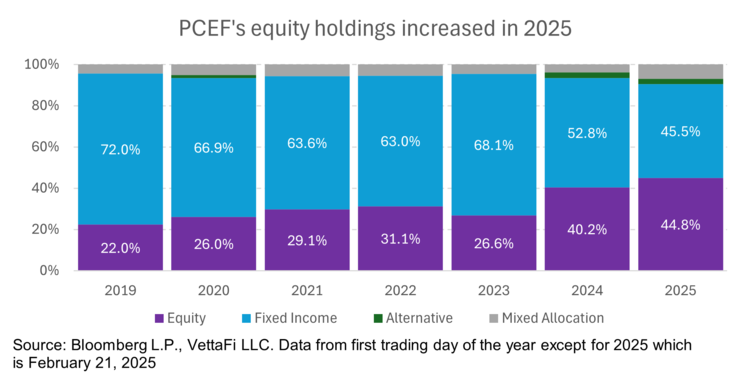
PCEF takes a broad view of the taxable closed-end fund market and invests in taxable investment-grade fixed income CEFs, taxable high yield fixed income CEFs, and equity option CEFs. PCEF gives a larger weight to holdings with wider discounts to net asset value (NAV). Buying CEFs at wider discounts has historically led to higher returns. Buying CEFs at excessive premiums can be associated with distribution cuts. Although this is a passive ETF, quarterly rebalances and reconstitutions help keep the weights tilted toward funds with higher discounts. Currently, the ETF has around 45% equity CEFs and 46% fixed income CEFs. The remaining amount is in alternative and mixed allocation funds.
Although the fund-of-funds structure has a higher expense ratio, PCEF provides the diversification that a single CEF doesn’t have. So an investor may invest in individual closed-end funds, but also use PCEF as a core holding (similar to tactically investing in individual stocks but maintaining a large-cap domestic equity ETF as a core holding). PCEF can also be used by investors who are interested in the high distributions from the closed-end fund space but don’t know where to start with CEF investment.
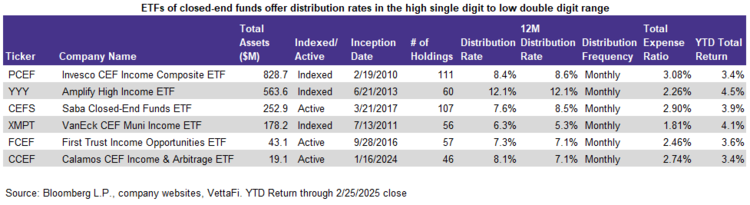
CEFs are not just a wrapper, but a way to generate income
The closed-end fund structure is a wrapper, much like the traditional open-ended ETF structure is a wrapper. But one of the main differences for investors is that CEFs primarily serve as income-generating products with total return as a secondary objective. On average, closed-end funds pay distributions in the high single-digit to low-double-digit percentage range. As with any security selection, it can be difficult to predict the timing of distribution cuts. That is why an ETF may diversify away some of that risk. With passive products like PCEF, an investor can get a broad range of diversification among funds, sectors, and managers. Looking at distributions, passive ETFs actually tend to do better than active ETFs. Passive ETFs have distributions in the high-single-digit and low-double-digit range.
PCEF reflects change in the broader taxable CEF universe
When many investors think of CEFs, they think of fixed income funds that used preferred shares as leverage. But recent years have marked a departure from when equity funds were only a small portion of PCEF’s holdings.
Prior to 2024, equity was anywhere from 22% to 31% of PCEF’s weight. Fixed income was the bulk of the weight. Interestingly, from 2023 to 2025, the absolute number of equity funds in the ETF grew from only 27 to 30. The number of fixed income funds fell from 85 to 72. This means that the change in allocation was mostly due to weighting methodology (applying weights to funds with higher discounts) rather than the actual number of each type of fund in the ETF.
Change in top holdings reflects growth in addition to income
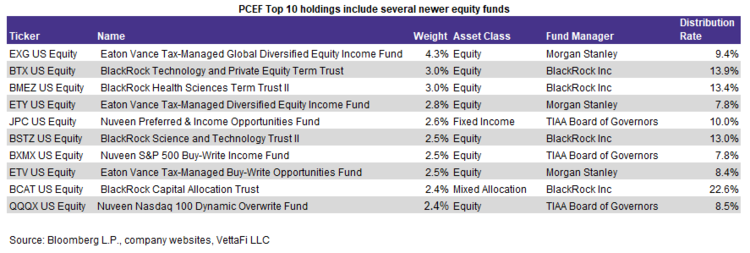
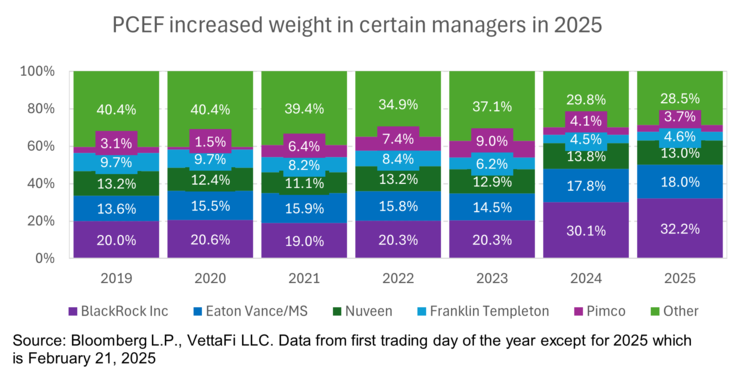
PCEF diversifies away some risk, but it is more concentrated among a few managers than the broader CEF universe. In 2025, PCEF had a 10%+ increase in exposure to BlackRock since 2023. And the number of BlackRock funds increased from 18 to 24 (adding BTX, BCAT, BMEZ, BSTZ, ECAT, and BUI). That approximately accounts for the increase of funds mentioned above. These are newer equity funds and all except BUI are in the top holdings.
For instance, the BlackRock Technology and Private Equity Term Trust (BTX) is currently the second largest holding in PCEF. BTX is a closed-end fund that focuses primarily on technology companies and privately held companies. The third and sixth largest holdings are the BlackRock Health Sciences Trust II (BMEZ) and the BlackRock Science and Technology Trust II (BSTZ). These funds also focus on healthcare tech, science, and technology companies.
Aside from BlackRock, there was a slight increase in exposure by weight to the second and third largest managers in the fund from 2023 to 2025 — Eaton Vance and Nuveen. Allocation to “other” funds was down to less than 30%. These include other popular funds by managers like John Hancock, First Trust, Prudential Financial, Virtus, and DoubleLine. Notably, PCEF also shed its former top holding, the Pimco Dynamic Income Fund (PDI) — a global credit fund. It was 4.6% of the ETF’s weight in 2022-2023.
For more news, information, and strategy, visit ETFDB.
VettaFi LLC (“VettaFi”) is the index provider for PCEF and XMPT, for which it receives an index licensing fee. However, PCEF and XMPT are not issued, sponsored, endorsed, or sold by VettaFi, and VettaFi has no obligation or liability in connection with the issuance, administration, marketing, or trading of PCEF and XMPT.

