
More than three quarters of S&P 500 companies have already reported fourth quarter earnings, FactSet data shows, and this week Nvidia joined them. The release after market hours on Wednesday was highly anticipated, so here we are, talking about little else.
If you recall, the company’s stock price rallied into the earnings report more than 3% that day. When results beat estimates, it reassured market bulls that artificial intelligence-related momentum remains positive. That said, it wasn’t all sunny skies. There were a few spots of concern for the chipmaker and the theme, more broadly, tied to competition, tariffs, supply chain and onshoring — all themes we have been closely watching.
Going into the earrings report, Bloomberg Senior ETF Analyst Eric Balchunas shared an interesting chart that caught my eye. As he pointed out, it plotted ETF issuers’ exposure to technology names across their ETF lineups. In other words, the chart showed how vulnerable these asset managers would be to a negative surprise on Nvidia, or to any kind of meaningful pullback from tech and AI as a theme. Here’s that chart:
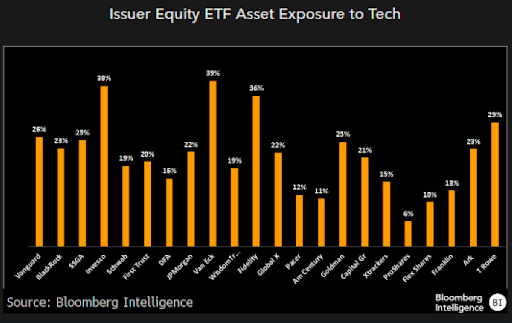
This chart is a great illustration of the problem of concentration. Many of us have been a little worried that our portfolios are top heavy, tech heavy, Mag Seven heavy, Nvidia heavy.
Light Shines on AI Overexposure
All of that weight is coming into sharp focus, as we fret about the pace of artificial intelligence investment and expansion. The recent DeepSeek scare threatened the bullish narrative we’ve all come to buy into. There were reports that Microsoft’s appetite for data center space may be slowing down. There are questions about trade policy and manufacturing capabilities domestically. No one questions that a tech-led AI investment opportunity exists for the long run. This is a multiyear theme. But there are growing concerns that we may be getting ahead of ourselves.
However you feel about AI as an opportunity set, if you are an ETF investor, there are a few things to consider from the latest moment in Nvidia’s and AI’s stories.
- You may have unintentional overexposure with ETFs.
- You may tackle that kind of risk while staying invested with ETFs.
Nvidia Here, Nvidia There, Nvidia Everywhere
The first point is that concentration on Nvidia may very well be real for many. Not because it sits highly across many large-cap tech portfolios, but because it sits across many, many portfolios.
Our ETFdb data shows that Nvidia is found in more than 750 ETFs today, and more than 330 of them hold the stock among top 15 holdings. If you own a few of these funds in an equity sleeve, you may be leaning into Nvidia significantly.
The chipmaker is the second biggest holding in the Nasdaq 100 and in the S&P 500 indexes, which benchmark some of the biggest ETFs in the market today. It’s not surprising that just about every large-cap equity, growth, and technology sector ETFs hold Nvidia prominently. It’s also a big holding in industry-specific and artificial intelligence thematic portfolios. If you invest in any of these parts of the market, you own Nvidia.
Some of the biggest positions sit in funds like the VanEck Semiconductor ETF (SMH ), the iShares Global Tech ETF (IXN ), the American Century Focused Dynamic Growth ETF (FDG ) and Fidelity MSCI Information Technology Index ETF (FTEC ), each between 15% and 20%.
Broader favorites like SPDR S&P 500 ETF Trust (SPY ) and Invesco QQQ Trust (QQQ ) have the stock at just under 10%. And leverage, single stock portfolios can go as high as 200% — just look at the GraniteShares 2x Short NVDA Daily ETF (NVD ), for example.
But did you know you may also own Nvidia among other strategies, such as in some ESG darlings? If you are an ESG-enthusiast or an impact investor, you may be holding Nvidia among top holdings in that part of your portfolio, too.
The SPDR MSCI USA Climate Paris Aligned ETF (NZUS ), looks for stocks among large- and midcap names in the MSCI USA, looking for companies that offer sustainable investment opportunity while minimizing climate risk. Nvidia is the top holding in that portfolio.
Nvidia is also the top holding in the BNY Women’s Opportunities ETF (BKWO ). According to the fund’s methodology and screening process, the chipmaker is not only attractive from a financial perspective. It’s also committed to gender equity and supportive of women’s careers and development. Nvidia is the fund’s largest allocation.
It turns out that if you are a value investor, looking to capitalize on stocks that are considered attractively valued, you may also own Nvidia there, too. The stock is among the top three holdings in the Fidelity Value Factor ETF (FVAL ).
The point is that if are worried that you own too much Nvidia in your tech and growth positions, remember that the diversity of ETF strategies and methodologies mean you may own the stock in multiple places across your portfolio.
Nvidia for a Cautious Investor
The second point is that ETFs are an excellent problem solver.
It could be that you want to remain invested in Nvidia — and AI more broadly — but you are growing cautious. You like the growth. You like the momentum. And you like the excitement of this theme. But you are getting heartburn, because aversion to downside is a real thing.
There are several ETFs that offer access to Nvidia, while achieving something else, too.
For example, you can manage downside risk in a tech-heavy portfolio today with funds like the Innovator Nasdaq-100 Managed Floor ETF (QFLR ). About 8% of the portfolio is tied to Nvidia. With QFLR you are getting upside capture on the Nasdaq 100. At the same time, you are also mitigating downside risk through an options overlay. It’s giving up a little bit of the upside for a good night of sleep.
The Global X NASDAQ 100 Tail Risk ETF (QTR ), too, offers uncapped upside capture on the Nasdaq 100 — about 8% Nvidia — but a protective buffer against market weakness. The JPMorgan Hedged Equity Laddered Overlay ETF (HELO ) is another interesting fund in the risk-management category. There are many.
Another way to access Nvidia is through an income lens. A fund like the NEOS Nasdaq 100 High Income ETF (QQQI ) offers exposure to Nvidia while providing high income through an options overlay. QQQI is an example of the derivatives-based income-generating plays around the Nasdaq 100. It generates yield from your tech allocation.
Other asset managers such as Global X and JP Morgan also have ETFs in this space. The Natixis Gateway Quality Income ETF (GQI ) is another one, with just over 6% allocation to Nvidia. The list goes on.
Know What You Own
As investors, it’s a battle between capitalizing on the AI-led growth opportunity while managing concentration and risk. Finding the right balance is a big effort that’s unique to each investor’s risk tolerance profile.
If you are want to hone in on your Nvidia exposure across ETFs (or any other stock), consider starting your research here, with our ETF Stock Finder Tool. Input a single stock ticker to unlock a wealth of information about what ETFs hold what stocks to what amount.
It all comes down to taking a moment to really understand what you own.
For more news, information, and strategy, visit ETFDB.

