

The first rate cut of the year gives investors the opportunity to position their portfolios to capture future upside in certain sectors, should further cuts occur. History has an uncanny ability to repeat itself, and it’s telling us that we should target the financial sector.
Research from State Street Investment Management certainly supports the case for financials, especially following cuts. With an elevated interest rate environment, investors have been keeping financials at a distance based on ETF flows. However, banks have been exhibiting a strong earnings run thus far this year. State Street mentioned that 87% of financial firms bested their earnings expectations following Q2 results, which include 83% showing positive guidance for the full year — both data points were the second-highest across all sectors.
“Even after one of the strongest earnings seasons for any sector, Financials continues to trail the broad market,” noted State Street global head of research Matthew Bartolini. “And ETF flows show limited investment across the sector.”
History Favors Financials
Following a rate cut of 25 basis points, the prevailing sentiment is that the Fed will institute another cut before 2025 turns into 2026. Right now, the CME Group’s FedWatch shows an over 90% expectation that another cut will take place in October and over 70% in December. If those predictions fall in line with the Fed’s moves, then that certainly bodes well for financials, as history is on their side.
Because the GICS data for the financials sector is limited to 1988 and beyond, State Street looked at the returns from the Fama French Industry Classification. Using that classification data, they were able to track the sector’s performance since 1970 following a rate cut and indeed, history favors financials.
“Analyzing the six-month returns following every Fed rate cut since 1970 shows that Financials’ average six-month return following a Fed rate cut was 7.3%,” Bartolini noted. “This compares favorably to the market’s average 7.1% return.”
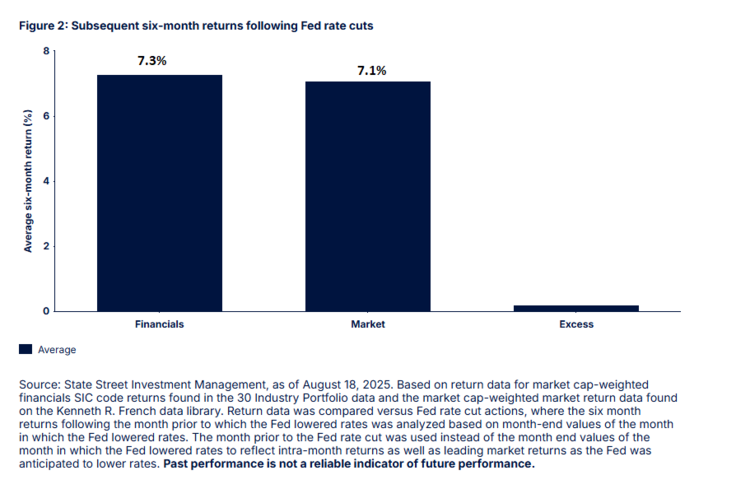
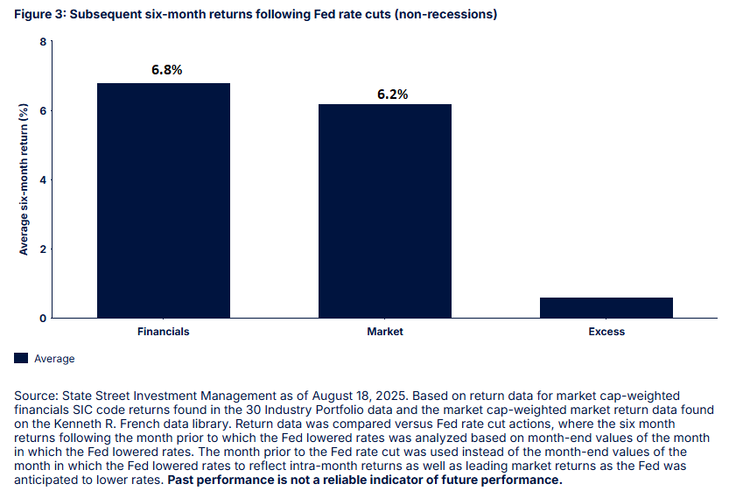
The performance disparity is even greater when removing rate cuts during a financial crisis and recession as seen below. As Barolini indicated, this better mimics the current macroeconomic environment, where a recession isn’t imminent despite subdued growth.
“Following rates cuts, in this more comparable data set, Financials still produces positive absolute returns (6.8%) but now with greater excess returns to the market (0.6% excess return versus 0.2% for all periods),” Bartolini added.
From a fundamental standpoint, falling interest rates can help stimulate demand for loan products that weren’t there the last few years. Financial services companies that draw a significant amount of revenue from consumer lending products like mortgages, car loans, and business loans can prosper in a low-rate environment.
All this said, it creates an opportunity to get exposure to an underinvested financials sector.
ETFs in Financials
Rather than build a portfolio of individual financial stocks, ETFs offer an ideal way to get broad exposure to the sector without the concentration risk. One fund of note is the Financial Select Sector SPDR Fund (XLF ), which tracks the Financial Select Sector Index. Berkshire Hathaway is the fund’s top holding, but the majority of the fund’s allocation include household names in the sector, like JP Morgan Chase, Visa, Mastercard, Bank of America, and Wells Fargo.
In addition to XLF, there are other heavy hitters in the industry that focus on broad financials exposure. Vanguard has the Vanguard Financials ETF (VFH ), BlackRock offers the iShares U.S. Financials ETF (IYF ), and Fidelity has the Fidelity MSCI Financials Index ETF (FNCL ).
Investors can also tailor their financials exposure specifically to banks. Those looking to target banks can look at funds like the Invesco KBW Bank ETF (KBWB ), SPDR S&P Bank ETF (KBE ), or the First Trust Nasdaq Bank ETF (FTXO ).
The Motley Fool noted that regional banks can also exhibit strength as deposit costs can adjust downward at a quicker pace due to their high rate sensitivity compared to loan yields. That said, investors may want to consider the SPDR S&P Regional Banking ETF (KRE ), iShares U.S. Regional Banks ETF (IAT ), or the Invesco KBW Regional Banking ETF (KBWR ).
For more news, information, and strategy, visit ETFDB.

