

Certainty is a scarce commodity these days. Amid stubborn inflation and geopolitical tensions, gold may have been one of the prime choices for commodities exposure. However, even gold lost its luster amid a volatile March. That said, the abrdn Bloomberg All Commodity Strategy K-1 Free ETF (BCI ) emerges as a high-conviction alternative to getting much-needed broad commodities exposure that extends beyond precious metals.
Key Takeaways
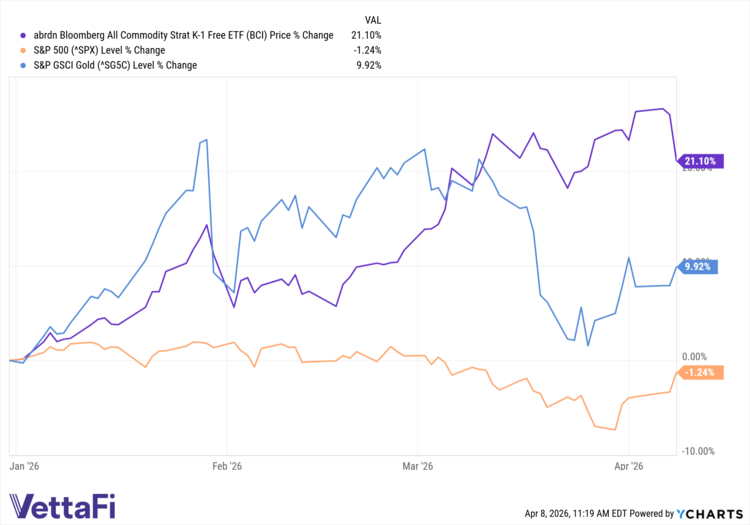
- BCI has outperformed the S&P 500 and gold year-to-date with a 21% gain, proving to be a high-conviction alternative for investors seeking resilient broad commodities exposure.
- While gold ETFs experienced a record $13 billion in outflows during March due to a climbing dollar and rising yields, broad-based commodity ETFs saw $1.3 billion in inflows, marking their 10th consecutive month of positive momentum.
- BCI eliminates the primary barriers to commodity investing. It uses a specialized structure that provides standard 1099 tax reporting instead of a Schedule K-1, while tracking a diversified index that limits sector and commodity concentration.
From a pure performance standpoint year-to-date, BCI is outpacing the S&P 500 as well as its related gold index with a 21% gain. For financial advisors seeking diversification for client portfolios with commodities exposure, BCI is more than just a momentum play. The fund is also strategically engineered to address two common headaches inherent in commodity investing: tax complexity and sub-sector volatility.
See More: The Power of Multi-Asset Investing
Broad Exposure Resilience
BCI’s performance underscores the need for broad commodities exposure compared to single-commodity allocation. According to State Street Investment Management’s March data, inflows in the commodities category further highlighted the need for diversified exposure.
Gold’s status as a safe haven asset was tested as ETFs tied to the precious metal saw a record $13 billion in outflows during March. With the U.S. dollar climbing alongside real yields, spot prices fell, which stifled the years-long rally in gold.
Nonetheless, as gold was faltering, the appetite for broad commodities was peaking. Broad commodity-based ETFs added $1.3 billion inflows during March, marking a record 10 consecutive months of inflows.
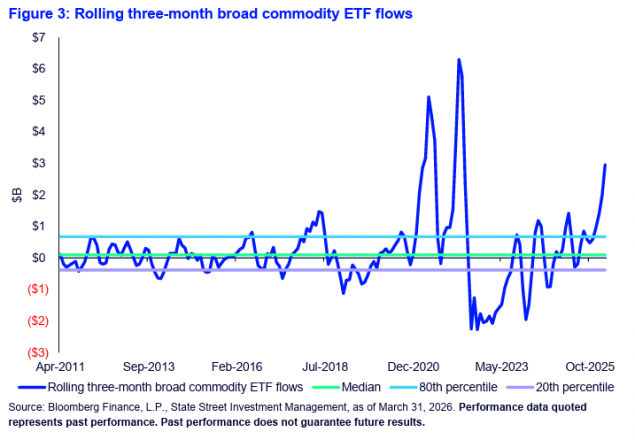
This inflows trend could indicate that investors are no longer viewing commodities as a speculative hedge. Instead, they could serve as a resilient component of a portfolio that can weather systematic risks like higher-for-longer inflation.
In summation, these macroeconomic realities drive the case for BCI and broad commodities exposure:
- Stubborn inflation: As State Street noted in their flash flows report, inflation was already sticky heading into the month of March. That said, broad commodities have a historically high correlation with Consumer Price Index (CPI) surprises, which make them ideal for mitigating inflationary risks.
- Geopolitical friction: With conflict in the Middle East affecting energy routes and supply chains remaining fragile, energy commodities saw a $2.3 billion inflow in March. BCI provides significant exposure to the energy complex (including crude oil and natural gas) while balancing that risk with agriculture and industrial metals.
- Diversification from gold: As mentioned, the $13 billion exodus from gold-related ETFS supports the case for broad exposure, especially when macro conditions like higher-for-longer rates apply downward pressure on precious metals. A broader, more diversified index like BCOM doesn’t necessarily move in lockstep with gold.
See More: March Madness: ETF Inflows Revealed an Emphasis on Defense
Under the Hood of BCI
BCI captures this broad-based commodities momentum by providing exposure to the Bloomberg Commodity Index Total Return (BCOMTR). This index represents the industry standard for diversified commodity exposure, consisting of 24 commodities futures contracts representing 22 distinct commodities.
A disciplined methodology governs the index construction. Components in the index are weighted 2/3 by trading volume and 1/3 by world production. The additional criteria is based on global economic significance. To ensure broad diversification, weight caps are applied to limit concentration in any particular commodity to 15% and any individual sector to 33%.
Current allocations into BCI (as of 12/31/25):
| Commodity Sector | Weight | Rationale and Key Drivers |
|---|---|---|
| Precious Metals | 29.31% | Geopolitical risks support gold as a safe haven, while industrial applications and solar panel production provide strong fundamentals for silver. |
| Agriculture | 26.66% | Driven by global demand for softs and grains; climate change impacts on crop yields create persistent supply shortages independent of geopolitical conflicts. |
| Energy | 22.79% | Demand generally rises with population and living standards, while investment in new supply infrastructure has historically lagged. |
| Industrial Metals | 15.91% | Aluminum, copper, nickel, zinc, and lead are critical, non-negotiable components of the global renewable energy transformation. |
| Livestock | 5.33% | Prices are influenced by drought conditions, rising feed and energy costs, and the increasing westernization in emerging markets. |
Tax Advantages
Historically, financial advisors have sidestepped commodities exposure due to the administrative burden associated with the Schedule K-1 tax form. Traditional commodity funds structured as partnerships typically require these forms, which may often arrive late in the tax season. This can induce angst, especially among high-net-worth clients. BCI completely eliminates this headache.
BCI gives investors full commodity exposure without issuing a K-1 form. Instead, the fund is designed to be taxed like a conventional mutual fund, and investors are issued a standard Form 1099 form. This makes it significantly easier for advisors to integrate broad commodities into a client’s portfolio while avoiding the K-1 form tax complexities.
In a year where volatility is forcing investors into defensive positions, BCI is already proving that the best defense can be a diversified offense. By combining the performance of the broad commodity sector wrapped in the convenience of an ETF, BCI offers financial advisors a compelling way to diversify portfolios with broad commodities. Again, it’s an ideal addition to a portfolio when certainty is becoming more rare as 2026 continues.
Originally published on Advisor Perspectives
For more news, information, and strategy, visit ETFdb.

