
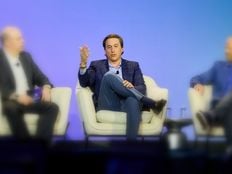
During Exchange 2026, experts and thought leaders from firms across the country gathered. They shared different approaches and ideas for tackling the market’s biggest challenges. Tyler Rosenlicht, Senior Vice President and Portfolio Manager at Cohen & Steers, sat down with VettaFi to break down the advantages of real assets, the Cohen & Steers investment approach, and more.
An Opportunity for Real Assets in 2026
Nick Wodeshick: So, much like 2025, worries of uncertainty are making investors and advisors pivot towards diversified approaches. Your team is obviously no stranger to real asset ETFs – are you expecting real asset strategies to have a strong use case this year?
Tyler Rosenlicht: Absolutely. We think real assets are a really good diversifier, and they should be a part of an investor’s portfolio at all times, but they particularly stand out during periods when uncertainty is high, inflation is accelerating, and interest rates are rising. Every situation is different, and not to sort of overhype one prior period, but you can just go back and look at 2022 where lots of uncertainty led to a big bit of inflation. Equities were down 18%, fixed income was down 16%, infrastructure was down 5%. We think about infrastructure as a low volatility, downside-protected equity allocation. Meanwhile, natural resources were up 10% and commodities were up 16%.
So, our core view for the next decade or two is that inflation’s going to be higher on average. It’s also going to be highly volatile. Particularly in periods when inflation is accelerating, you want to have real asset exposure in your portfolios.
CSNR's Approach to Natural Resources Exposure
Nick Wodeshick: On that note, Cohen & Steers had quite a few interesting funds, but the Cohen & Steers Natural Resources Active ETF (CSNR ) has been doing quite well this year in terms of performance. Can you talk a little bit about how the fund approaches natural resources exposure, especially given the situation unfolding in the Middle East?
Tyler Rosenlicht: The Natural Resources strategy has been one that we have managed for about 12 years. IT was launched in 2013, but we launched the ETFs last February. We want it to be an institutional quality global natural resource equities strategy. We want to get you exposure to the equities in the companies that participate in the broad resource equities value chain.
Some natural resource strategies are very energy-sensitive or very copper-sensitive or very thematic. We want to have exposure to a little bit of everything.
Roughly speaking, one third of the portfolio’s risk comes from metals, one third comes from energy, one third comes from agriculture. We’ve been of the view that hey, the cycle is really getting in the favor of natural resources for a few years, which is from massive underinvestment on the supply side of most commodities and demand for resources starting to accelerate with AI and electricity. That’s really starting to converge.
This year, we continue to think that the equities are still not discounting the future commodity price environment, and so it could be volatile with what’s going on in the Middle East, but we feel pretty good about the outlook as it stands today. What happened towards the beginning of March, we could characterize as a meaningful slow inflationary impulse. So, growth slightly slower, with inflation slightly higher. That’s a good thing for natural resources and real assets.
We are paying a lot of attention to whether it really lasts and if logistical constraints become a problem, other geopolitical events materialize. Do you tip into stagflation, where parts of real assets will do really well, and parts of real assets will do a bit less? We’re not there yet, but that’s kind of where we’ve started to see the economy shift in the favor of things like natural resources. We just want to make sure that it doesn’t get too far too fast, where you get a big growth slowdown.
Why Diversified Natural Resources Exposure Matters
Nick Wodeshick: Prior to the price downturn from geopolitical risks, many investors were seeking pure-play metal exposure for assets like gold and silver. Obviously, CSNR is a more diversified take on natural resources. What would you say to investors to help them understand why taking on more diversified natural resources exposure could be helpful?
Tyler Rosenlicht: It’s based on investor objectives. What a lot of people will say is that they want to have inflation beta in their portfolio—stuff that does well in years like 2022. What they’ve done in the past is allocated to more thematic portfolios, like copper-only strategies. And what happened is that they got the investment call, but copper proved to be really levered to rising interest rates that year, so copper underperformed. What we think is that if you want interest rate beta, you want to have a broad resource equity allocation.
Say you want to put $10 into natural resources. We think our strategy is designed to be a ballast, so $7 of that $10 should come to a diversified approach like ours. If you happen to be bullish towards copper, or uranium, or any other natural resource, put a dollar or two there. It’s kind of like a satellite to amplify a specific fundamental view. And so, if the objective is to assuage worries of a drawdown of equities and reaccelerating inflation, this approach will have a high correlation of protection in that sort of world.
Infrastructure's Compelling Opportunity Set
Nick Wodeshick: Another fund that you co-manage that I find interesting right now is the Cohen & Steers Infrastructure Opportunities Active ETF (CSIO). Now, I think infrastructure investing is a great choice right now, but can you help explain why the Cohen & Steers approach to infrastructure exposure could be a valuable addition to investor portfolios?
Tyler Rosenlicht: If we think of the benefits of an infrastructure allocation, to put it in a very simple phrase, it would be low volatility, downside protected equity exposure. So these are sort of high quality businesses that have very good predictability of cash flows and can generally pass inflation onto their end customers. It’s why in 2022, when equity was down 18%, infrastructure was only down 5%. We think hey it’s a really good way to retain the potential for equity upside while also sort of stepping away from some of the high valuations in the broad market while getting some downside protection.
We invest in the acute sub-sectors. Communications, utilities, transportation, and then within energy, the midstream, the pipeline segment of the value chain. We’re seeing really strong growth opportunities in each of them. So, communications, cell towers, data centers, satellites. Clearly if you’re bullish in AI, there’s a lot of demand growth for those utilities. We need to invest a lot in the electric grid, power generation transmission.
There’s nuance, but the growth opportunity is huge for transportation. The global supply chain is upending it. And then within midstream energy, our view is that we’re in this energy addition world. We need more of everything— more investments in renewables, but also more resilience and cashflow from traditional midstream and natural gas pipelines. Today, people want low volatility, they want downside protection, they want equity exposure and then they also want to have access to these mega themes. Infrastructure happens to offer each of those things too. So, we agree that it’s kind of like the right asset class and the right time for many investors.
The Importance of Affordability and Supply Chains
Nick Wodeshick: Are there any other trends, sectors, and themes that you and your team are keeping a close eye on right now?
Tyler Rosenlicht: Inside each of the industries we’ve talked about, we’re spending a lot of time on the themes. In infrastructure, one theme that we are most focused on is affordability. The blessing for utility is capital expenditures. However, the doom for utility is also capital expenditures because someone has to pay for ‘em. And so, we’re spending a lot of time trying to understand that we’re in a midterm election year and K-shaped economy. The average person feels like they’re being left behind. What are the ramifications of that going to be for an infrastructure asset owner? Some are going to really struggle, while some are going to benefit. That’s sort of like a sub theme that we’re very focused on the natural resources side.
We had a global natural resource system that, for 40 years, kind of adopted the Toyota Just-In-Time. We’re going to buy the goods from the cheapest source of supply when we need it. Maybe we can produce copper for $10 here, but we can produce it for $4 in China. Let’s just buy all of our copper from China. That’s proven to be a very fragile and challenging thing to work through.
And so now it’s going to be about, not just buying from the cheapest supplier. I want to buy from either myself and re-domesticate industries or let’s only transact with partners. Let’s build in redundancies, let’s build inventories. We think that the government is going to continue to work to catalyze the resurgence of these supply chains. You’ve seen it in rare earth, you’ve seen it in uranium and lithium. We think there’s going to be a lot more. And so that’s another sub theme that we think is not like a flash in the pan, but it’s something that’s going to continue for a while and we’re spending a lot of time trying to figure out who are going to be the relative winners and losers of that.
Exchange Highlights for Rosenlicht
Nick Wodeshick: Last but certainly not least, we are talking amid Exchange 2026! What are you looking forward to getting out of this conference, Tyler?
Tyler Rosenlicht: For us, our firm has been around for 40 years. We were early adopters of REITs as an asset class. Early adopters of real assets as an investment approach. We might be perceived as slow adopters of the ETF structure or ETF wrapper. We launched our first ETFs last February, and two more in December. We’re converting an open-end mutual fund into an ETF in a few months.
For us, it’s sort of about getting ourselves even more acquainted and acclimated with the ETF community. We’re really excited about the structure of the vehicles, and the investor adoption so far, but I think we’re still sort of perceived as newcomers here. So, for me, it’s about meeting the folks who are sort of ETF-first and making sure they know who we are and that we want to learn from them too.
For more news, information, and analysis, visit VettaFi | ETFDB.

