
ETFdb Logo
  • ETF Database
  • Content Hubs
    • Themes
      • Active ETF
      • Alternatives
      • Artificial Intelligence
      • China Insights
      • Core Strategies
      • Crypto
      • Disruptive Technology
      • Energy Infrastructure
      • ETF Building Blocks
      • ETF Investing
      • ETF Strategist
      • Financial Literacy
      • Fixed Income
      • Free Cash Flow
      • Future ETFs
      • Innovative ETFs
      • Institutional Income Strategies
      • Leveraged & Inverse
      • Market Insights
      • Market Outlooks
      • Modern Alpha
      • Nuclear Energy
      • Portfolio Strategies
      • Sector Investing
      • Tax Efficient Income
      • Thematic Investing
    • Asset Class
      • Equity
        • U.S. Equity
        • Int'l Developed
        • Emerging Market Equities
      • Alternatives
        • Gold/Silver/Critical Materials
        • Cryptocurrency
        • Currency
        • Volatility
      • Fixed Income
        • Investment Grade Corporates
        • US Treasuries & TIPS
        • High Yield Corporates
        • Int'l Fixed Income
    • ETF Ecosystem
    • ETFs in Canada
    • Market Outlook
    • Crypto ETF Hub
  • Tools
    • ETF Screener
    • ETF Country Exposure Tool
    • ETF Database Categories
    • Indexes
    • Scenario Analysis
    • Watchlists
    • Head-To-Head ETF Comparison Tool
    • Mutual Fund To ETF Converter
    • ETF Stock Exposure Tool
    • ETF Issuer Fund Flows
  • Research
    • ETF Education
    • Equity Investing
    • Dividend ETFs
    • Leveraged ETFs
    • Inverse ETFs
    • Index Education
    • Index Insights
    • Top ETF Sectors
    • Top ETF Issuers
    • Top ETF Industries
  • Webcasts
  • Sectors
    • Sector Investing Content Hub
    • XLK
    • XLI
    • XLU
    • XLY
    • XLP
    • XLRE
    • Sector Power Rankings
    • XLE
    • XLC
    • XLF
    • XLV
    • XLB
  • Multimedia
    • ETF 360 Video Series
    • ETF of the Week Podcast
    • Gaining Perspective Podcast
    • ETF Prime Podcast
    • Video
  • Company
    • About VettaFi
  • PRO
    • Pro Content
    • Pro Tools
    • Advanced
    • FAQ
    • Free sign up
    • Login
  1. Managing risk and capturing growth potential: Why invest in JQUA
News
Share

Managing risk and capturing growth potential: Why invest in JQUA

Special to VettaFiSep 02, 2020
2020-09-02

By J.P. Morgan Asset Management

The economic ripple effects of COVID-19 are hitting some companies harder than others. As the trend continues, passively buying broad benchmarks may expose investors to unstable companies and unwanted risks. Instead, investors may want to consider a strategy that targets the highest quality businesses with high profit margins and low debt levels. The JPMorgan U.S. Quality Factor ETF seeks to own the highest quality stocks in each sector, which can help investors to weather market downturns and also participate in upswings.

Why it’s high time for high quality

Lockdown efforts aimed at mitigating the virus will likely trigger a severe economic slowdown and, in turn, an earnings recession for U.S. corporations. Profits were slowing even before the pandemic, and forecasts have worsened since. The latest earnings estimates range from steep declines in more sensitive sectors like energy and industrials, to modest growth in more insulated industries such as technology and utilities.

Earn 1 CE Credit on Sept. 30! Webcast: Focus on Quality to Navigate Changing Markets

Meanwhile, corporate leverage has climbed to its highest level in years, raising solvency concerns among the more financially vulnerable holdings in traditional indexes. Against this backdrop, JQUA’s focus on higher-quality, stable companies offers a solution for staying invested through the uncertainties. JQUA seeks to:

• Manage risk and limit losses during volatile periods. Quality was one of the few equity styles to post positive excess returns as stocks sold off sharply in the first quarter. Relative performance was especially strong in March, as investors gravitated toward the types of large, high-quality businesses we favor.

• Capture growth potential as markets recover. Quality stocks have historically outperformed the broad market across cycles, with less risk. Adding exposures now allows investors to access growth opportunities as they arise and enhance long-term return potential as we move through and beyond the pandemic.


Content continues below advertisement

Chart 1: Higher returns with lower risk: U.S. Quality factor ETF vs. Russell 1000 Index

JQUA benchmark sheet
J.P. Morgan Asset Management, time period is since inception, 10/16/17, to 6/30/20. Returns stated at NAV. The performance quoted is past performance and is not a guarantee of future results. Investment returns and principal value of an investment will fluctuate so that an investor's shares, when sold or redeemed, may be worth more or less than original cost. Current performance may be higher or lower than the performance data shown. For performance current to the most recent month end please call 1-844-4JPM-ETF.

Three-step process for constructing a high-quality equity ETF

As part of our suite of factor-based equity strategies, JQUA brings J.P. Morgan’s quantitative research, portfolio management, technology and trading capabilities to an ETF priced at just 0.12%. Rather than buy every name in the Russell 1000, the index targets the 200 to 300 highest-quality U.S. large cap companies across all sectors to offer similar sector exposure without the significant stock concentrations of traditional indexing.

Step 1: Align sectors with the market. JQUA’s process begins by matching the sector allocations of the Russell 1000, and realigning them back during each quarterly rebalance. We align sectors to the index to avoid sector bets and ensure that the exposure to high-quality companies is what drives the fund’s performance relative to the Russell 1000.

Step 2: Rank stocks within each sector. When determining the overall quality of each company, our rules-based approach ranks sector peers based on three key quality pillars:

• Profitability – strong earnings and cash flow

• Financial risk – low leverage, high interest coverage, low share price volatility

• Earnings quality – consistent accounting practices

Step 3: Select and weight stocks. We own the highest-ranked companies in each sector and seek to avoid overconcentration, thereby reducing stock-specific risks while maintaining diversification and liquidity.

Chart 2: JQUA seeks quality companies with higher profits and less debt
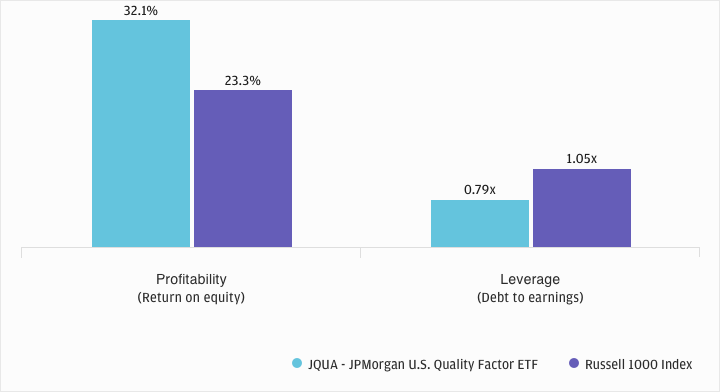
Volatility JQUA ETF Chart
Source: FactSet, Bloomberg, J.P. Morgan Asset Management. Data as of 6/30/20. Profitability is measured by Return on Equity (ROE) which is based on trailing 12 months income. Leverage is measured by Debt to Earnings which is defined as total debt divided by last 12 months EBITDA. Past performance is no guarantee of future results.

JQUA plays multiple roles in strong portfolios

With its targeted exposure to quality companies, JQUA aims to serve as a core holding alongside standalone value and growth strategies. It also aims to act as a core complement to round out existing portfolio positions or bolster overall quality exposure in one simple trade. Or, consider it as a tactical allocation as outlooks change in today’s fast-moving markets.

Looking ahead, we expect to see increased discrepancies among company fundamentals as winners and losers emerge from the COVID-19 crisis. As always, we will look to improve on traditional beta by separating the most attractive stocks from the rest of the broad index.

Learn more about JPMorgan U.S. Quality Factor ETF ►

JQUA RISK SUMMARY: : Investments in mid cap companies may be riskier, less liquid, more volatile and more vulnerable to economic, market and industry changes than investments in larger, more established companies. Share price changes may be more sudden or erratic than the prices of other equity securities, especially over the short term.


Click here for JQUA standardized performance

» Popular Pages

  • Tickers
  • Articles

Jun 24

Long-Term Outlook Brightens for This Nuclear ETF

Jun 24

Owning Up to What We Owe

Jun 24

Midyear Market Outlook Symposium to Provide Essential Overview

Jun 24

The Fed Says Less

Jun 24

3 Companies Redefining Healthcare Innovation

Jun 24

The Market May Be Getting It Wrong With SoFi

Jun 23

Active Tech ETF GTEK Delivers Smashing YTD Performance

Jun 23

Biotech ETFs Gain Momentum via AI Drug Discovery & Surging M&A

Jun 23

Bitcoin Miners Are Winning the AI Boom

Jun 23

Which Route During a Tech Rout? Two Low Volatility ETFs

QQQ

Invesco QQQ Trust Series I

VOO

Vanguard S&P 500 ETF

GLD

SPDR Gold Shares

SMH

VanEck Semiconductor ETF

DRAM

Roundhill Memory ETF

SOXX

iShares Semiconductor ETF

PPLT

abrdn Physical Platinum...

SIVR

abrdn Physical Silver Shares...

SCHD

Schwab US Dividend Equity ETF...

SOXL

Direxion Daily Semiconductor...


Content continues below advertisement

Loading Articles...

Advertisement

Is Your Portfolio Positioned With Enough Global Exposure?

ETF Education Channel

How to Allocate Commodities in Portfolios

Tom LydonApr 26, 2022
2022-04-26

A long-running debate in asset allocation circles is how much of a portfolio an investor should...

Core Strategies Channel

Why ETFs Experience Limit Up/Down Protections

Karrie GordonMay 13, 2022
2022-05-13

In a digital age where information moves in milliseconds and millions of participants can transact...

}
X