

When pondering career aspirations, not many children say, “I want to be a financial advisor when I grow up.” Given the latest employment data, parents may want to consider planting that idea seed, especially with the fear of AI disrupting certain industries.
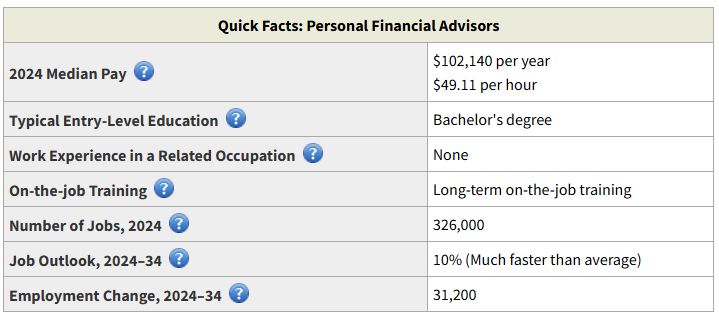
Projections directly from the U.S. Bureau of Labor Statistics show that personal financial advisors will be in demand for the next decade. The job outlook through the year 2034 shows the growth rate for personal financial advisors is 10% or 7% higher than the average for all occupations.
With the advent of robot advisors and AI, the data may appear to run counter to industry assumptions given the rapid pace of technological advancement. However, further data supports the need for advisors — especially those made of flesh and bone. It’s further evidence that when it comes to taking financial advice, humans still prefer their own kind.
Not So Fast, AI
With much of the stock market performance this year driven by AI, it’s difficult to avoid the topic of AI technology supplanting humans in certain industry sectors. According to data from research firm McKinsey & Company, financial advisory is not one of them.
In the manufacturing sector, machines are already replacing the need for human labor on assembly lines. In the healthcare sector, the increased usage of robots to perform surgeries is already a thing. But as far as delivering financial advice goes, the McKinsey report also confirmed that humans still prefer humans.
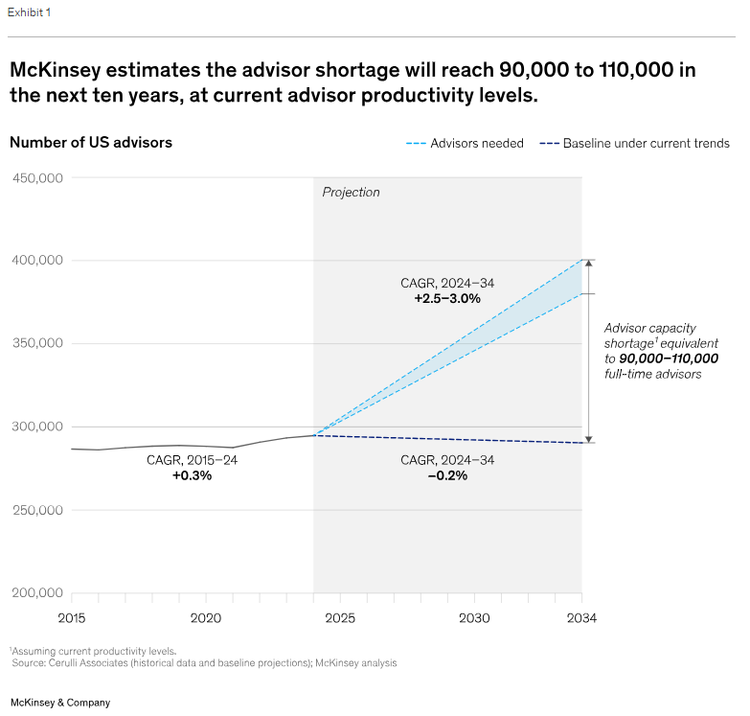
If advisor productivity levels stay at the current pace, McKinsey posits that by the year 2034, the number of financial advisors will decline to a level where there’s a shortage of 100,000 advisors. At the current speed of technology, it might seem plausible that AI or robots could help fill that void. It’s much easier to build machines or software than it is to create more humans. And it’s an additional task to steer humans into a future career in financial advising. Nonetheless, in the end, humans are still craving that personal touch that only another human can bring.
The demand drivers for financial advice seeking include the rising wealth of the U.S. population. McKinsey projects that the number of affluent households (those with investable assets of $500,000 or more) will grow at a rate of 4% to 5%. That bodes well for the financial advisory business.
A Potentially Cheaper Alternative
“Demand for its services continues to grow as Americans become wealthier and their needs become more complex—for example, because of greater reliance on personal savings for retirement than in prior generations and the proliferation of sophisticated financial products to maximize wealth accumulation and preservation,” McKinsey noted. “This increasing demand is illuminated by clients’ growing willingness to pay for human-delivered advice.”
Furthermore, these wealthier households are willing to pay for financial advice, as a survey by McKinsey indicated. Technology like AI could present a cheaper alternative to human-delivered advice. But it’s not an open-and-shut case of “If you build it, they will come.” When it comes to families with higher net worths, it’s closer to “If humans deliver it, they will pay.”
“Almost 80 percent of affluent households surveyed indicate that they would rather pay a premium of 50 basis points or more for human advice than use a customized digital advice service priced at about ten basis points; 29 percent say they are willing to pay a premium of 100 basis points or more,” the McKinsey report said, referencing a survey they conducted on affluent and high-net-worth investors.
Flesh & Bone Over Algorithms
Vanguard, a stalwart in the financial industry regarding offering low-cost indexed funds, also conducted its own survey of 1,500 investors who currently use the services of a financial advisor. Ultimately, the goal of the survey was to gauge the perception on traditional versus digital financial advice. The results were similar to McKinsey’s. Ninety-three percent of respondents would rather maintain that client/advisor relationship that centers on human interaction.
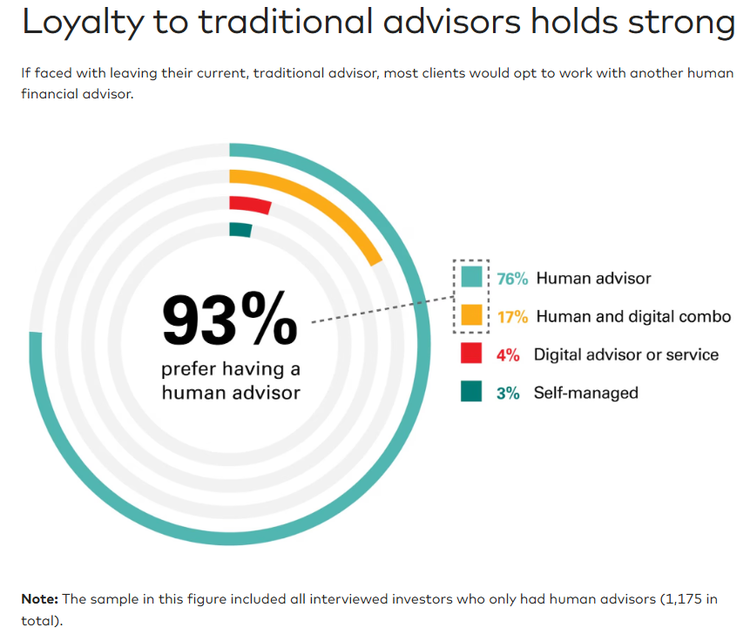
“Most investors desire a personal connection with a traditional financial [advisor. That’s] even if they do not use one currently,” Vanguard noted. “This indicates strong potential for advisors to showcase their value and encourage digital-only investors to sign up as clients.”
It’s difficult to a posit a world in which AI, machine learning, and other disruptors completely fall to the wayside as humans triumph over their technological counterparts. Ideally, humans will be able to leverage these technologies to enhance their current productivity levels. That includes the use of AI — a world where humans work alongside technology in perfect harmony.
But for now, when it comes to financial advising, humans can say, “Don’t worry AI; I got this.”
Originally published on Advisor Perspectives
For more news, information, and analysis, visit VettaFi | ETFDB.

