ETFdb Logo
  • ETF Database
  • Content Hubs
    • Themes
      • Active ETF
      • Alternatives
      • Artificial Intelligence
      • China Insights
      • Core Strategies
      • Crypto
      • Disruptive Technology
      • Energy Infrastructure
      • ETF Building Blocks
      • ETF Investing
      • ETF Strategist
      • Financial Literacy
      • Fixed Income
      • Free Cash Flow
      • Future ETFs
      • Innovative ETFs
      • Institutional Income Strategies
      • Leveraged & Inverse
      • Market Insights
      • Market Outlooks
      • Modern Alpha
      • Nuclear Energy
      • Portfolio Strategies
      • Sector Investing
      • Tax Efficient Income
      • Thematic Investing
    • Asset Class
      • Equity
        • U.S. Equity
        • Int'l Developed
        • Emerging Market Equities
      • Alternatives
        • Gold/Silver/Critical Materials
        • Cryptocurrency
        • Currency
        • Volatility
      • Fixed Income
        • Investment Grade Corporates
        • US Treasuries & TIPS
        • High Yield Corporates
        • Int'l Fixed Income
    • ETF Ecosystem
    • ETFs in Canada
    • Market Outlook
    • Crypto ETF Hub
  • Tools
    • ETF Screener
    • ETF Country Exposure Tool
    • ETF Database Categories
    • Indexes
    • Scenario Analysis
    • Watchlists
    • Head-To-Head ETF Comparison Tool
    • Mutual Fund To ETF Converter
    • ETF Stock Exposure Tool
    • ETF Issuer Fund Flows
  • Research
    • ETF Education
    • Equity Investing
    • Dividend ETFs
    • Leveraged ETFs
    • Inverse ETFs
    • Index Education
    • Index Insights
    • Top ETF Sectors
    • Top ETF Issuers
    • Top ETF Industries
  • Webcasts
  • Sectors
    • Sector Investing Content Hub
    • XLK
    • XLI
    • XLU
    • XLY
    • XLP
    • XLRE
    • Sector Power Rankings
    • XLE
    • XLC
    • XLF
    • XLV
    • XLB
  • Multimedia
    • ETF 360 Video Series
    • ETF of the Week Podcast
    • Gaining Perspective Podcast
    • ETF Prime Podcast
    • Video
  • Company
    • About VettaFi
  • PRO
    • Pro Content
    • Pro Tools
    • Advanced
    • FAQ
    • Free sign up
    • Login
  1. A Tale of Two Emerging Market Bond ETFs: EMB vs. LEMB
News
Share

A Tale of Two Emerging Market Bond ETFs: EMB vs. LEMB

Daniela Pylypczak-WasylyszynApr 21, 2015
2015-04-21

Emerging Markets Bond ETFs have always been a popular choice for investors looking to diversify the fixed income portion of their portfolios. In recent months, however, we’ve witnessed a significant divergence amongst these products.

U.S. Dollar vs. Local Currency Denominated Options

Emerging markets bond ETFs can offer investors exposure to two different types of debt: one that is denominated in local currency, and another that is U.S. dollar denominated. Take for example two popular iShares ETFs: the J.P. Morgan USD Emerging Markets Bond ETF (EMB A-) and the Emerging Markets Local Currency Bond ETF (LEMB A-).

These two funds both target government bonds issued by emerging market countries. LEMB and EMB have roughly the same size portfolio, consisting of over 200 securities. The main difference between these two funds, besides the slightly different country allocations, is that EMB invests in only U.S-dollar denominated bonds while LEMB invests in local currency denominated bonds.

When the U.S. dollar is not exhibiting any significant fluctuations, these two funds typically perform in line with each other. But with the U.S dollar’s rally over the last year or so, the performance of EMB and LEMB have differed significantly.


Content continues below advertisement

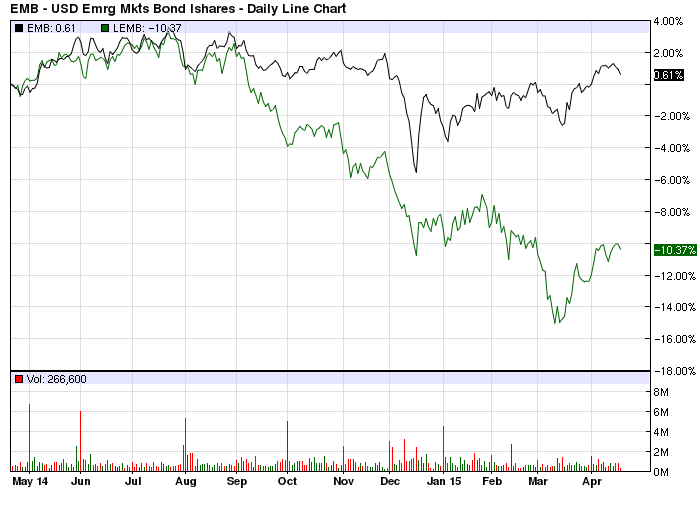
1-Year Performance: EMB vs LEMB

1-Year Performance of EMB vs LEMB

Over the trailing 1-year period, LEMB has taken a steep hit, losing over 10%, while EMB has managed to eke out a gain of about 0.60%. As mentioned, the main driver for this divergence has been the strength of the U.S. dollar. Illustrating this point is the below chart of the Dreyfus Emerging Currency Fund (CEW A-), which tracks fluctuations across a basket of emerging market currencies relative to the U.S. dollar:
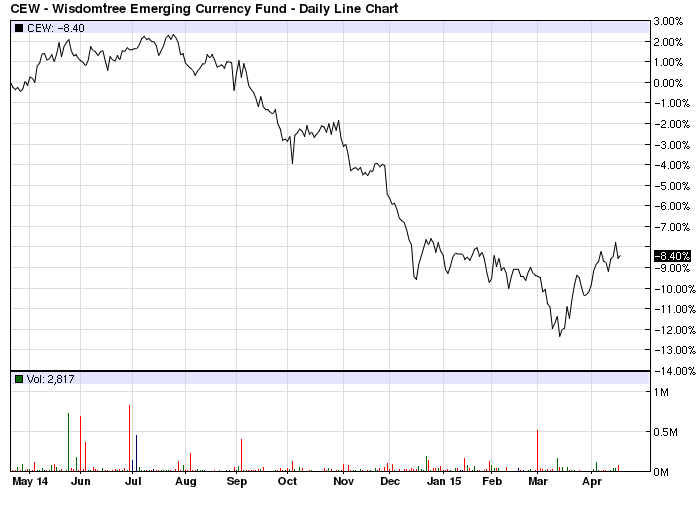
CEW 1-year trailing return

Not surprising, investors’ risk appetites for local-currency denominated emerging market debt has waned significantly. From April of 2014 to April of 2015, LEMB only saw net flows of $99 million in assets, while EMB managed to rake in roughly $466 million in assets during the same period.

The same trend can be seen in emerging market equities, with investors opting for currency-hedged products.

Putting It All Into Perspective

While on paper EMB seems to be a clear-cut “winner”, it is important to realize that the fund’s performance relies greatly on the fact that its underlying holdings are directly linked to the performance of the U.S dollar. Furthermore, emerging markets as a whole have struggled to gain ground over the last year or so, primarily due to the fact that the U.S. dollar has risen so much.

Remember that those countries with U.S. dollar denominated debt are running into major problems keeping up with the U.S. dollar’s pace, since payments on that dollar debt continue to become more and more expensive.

Another key relationship investors must understand is the one between the U.S. dollar, commodity prices, and emerging markets. When the greenback rises, commodity prices tend to fall, since a strong dollar causes buyers to pay more for the U.S. dollars used to buy commodities (which are typically priced in U.S. dollars). Consequently, falling commodity prices have significant impacts on many emerging markets, since commodity exports make up a large portion of these economies’ GDPs.

Last but certainly not least, investors have already begun making the shift away from emerging market – and even foreign fixed income securities – towards the U.S. in anticipation of a rate hike by the Fed. U.S. government bonds, which have historically been an investor staple, have yielded next to nothing for investors. A slight uptick in interest rates combined with the U.S.’s top-notch credit quality will once again make these bonds more attractive for those investors tired of hunting for yield in the junk bond space.

As always, we encourage you to keep a close eye on these market and macroeconomic trends.

Follow me on Twitter @DPylypczak.

Disclosure: No positions at time of writing.

» Popular Pages

  • Tickers
  • Articles

Jun 26

European Defense ETF: Maybe a Dip Worth Buying

Jun 26

From Tech Giants to MANGOS: A New ETF Trend Emerges

Jun 26

Leaving on Your Terms: Planning Your Exit

Jun 26

The Weekly Wire: "Inflation Is A Choice"

Jun 26

Yields Rise As The Fed Begins “A New Chapter”

Jun 26

Income ETF GPIQ Tracking to Double AUM This Year 

Jun 26

SDOG: The High Dividend ETF With More Perks

Jun 26

Bitcoin & the Risk-Off Rotation: What Advisors Should Watch

Jun 25

American Century’s Gotelli Talks Muni Bond Trends

Jun 25

Qualcomm Data Center Plans Put These ETFs in the Spotlight

QQQ

Invesco QQQ Trust Series I

VOO

Vanguard S&P 500 ETF

DRAM

Roundhill Memory ETF

GLD

SPDR Gold Shares

SMH

VanEck Semiconductor ETF

SOXX

iShares Semiconductor ETF

PPLT

abrdn Physical Platinum...

SIVR

abrdn Physical Silver Shares...

SCHD

Schwab US Dividend Equity ETF...

SOXL

Direxion Daily Semiconductor...


Content continues below advertisement

Loading Articles...

Advertisement

Is Your Portfolio Positioned With Enough Global Exposure?

ETF Education Channel

How to Allocate Commodities in Portfolios

Tom LydonApr 26, 2022
2022-04-26

A long-running debate in asset allocation circles is how much of a portfolio an investor should...

Core Strategies Channel

Why ETFs Experience Limit Up/Down Protections

Karrie GordonMay 13, 2022
2022-05-13

In a digital age where information moves in milliseconds and millions of participants can transact...

}
X